
📌 Introduction
You opened your gas booking app this month and did a double-take, right? Because we all did. The LPG price hike of May 2026 has hit Indian households like a gut punch — especially when you’re already managing rising grocery bills, school fees, and everything else. The 19kg commercial cylinder has crossed ₹3,000 for the *very first time* in history. And the new booking rules? Even more confusing. But don’t worry — this guide is your one-stop breakdown. We’ll walk you through what changed, how to book your Indane, Bharat Gas, or HP Gas cylinder without any headache, and exactly what to watch out for.
**I was watching news what i was observed is panic and swift reaction, So i think being confident that we will find some way to get out of this situation is crucial and we must control our reactions to rumours is the best thing we can do**
📊 Section 1 — The LPG Price Hike of May 2026: How Shocking Is It Really?
Let’s start with the numbers, because they tell the whole story.
In metro cities, the jump ranges anywhere between ₹993 and ₹1,147 per cylinder — and for the very first time, the 19kg cylinder has breached the ₹3,000 ceiling. That’s not a small bump. That’s a historic crossing of a psychological price barrier that millions of Indian households have never seen before.
The domestic 14.2kg cylinder price, however, has remained unchanged — still sitting at ₹913 in Delhi, ₹939 in Kolkata, ₹912.50 in Mumbai, and ₹928.50 in Chennai. So if you’re a household user, your 14.2kg cylinder price hasn’t moved — but if your business, restaurant, or dhaba runs on 19kg cylinders, you are feeling serious pain right now.
🌍 Why Did This Happen? The Global Trigger
The US-Israel-Iran war escalated dramatically, leading to the shutdown of the Strait of Hormuz — one of the world’s most critical oil and gas transit routes — pushing oil marketing companies to pass the shock on to consumers, with three separate rounds of 19kg price hikes between March and April 2026 alone. India imports a massive share of its LPG, and when global supply routes break down, we feel it directly in our kitchens.
🏠 The PNG vs LPG Crackdown You Need to Know About
In response to the crisis, the government has started identifying households that hold both LPG and PNG (Piped Natural Gas) connections, with a firm plan to ban dual ownership and remove LPG connections wherever PNG infrastructure already exists the deadline for this is likely June 2026. If you live in a society with PNG, don’t wait act now.
*Government started taking steps to save LPG for future Also the awareness of consumers matters more and decisive, Dual ownership can also make scarcity even worse and situation more panicking *
📋 How to Book Indane Gas, Bharat Gas & HP Gas in May 2026 (Step by Step)
Good news: even though prices are rising, booking has actually gotten *easier* and more digital. Nearly all LPG bookings — a staggering 99% — are now happening online, and 94 out of every 100 deliveries now use the DAC (Delivery Authentication Code) system to ensure your gas reaches the right hands. Here’s everything you need to know, provider by provider.
🔵 How to Book Indane Gas — Indian Oil Corporation (IOCL)
Indane Gas offers multiple ways to book a refill — all from your registered mobile number. Follow these four universal steps regardless of which channel you choose:
**Step 1:** Pick your preferred booking method from the options below.
**Step 2:** Always use your **registered mobile number** — the one linked to your Indane consumer ID.
**Step 3:** After booking, you’ll receive a **DAC (Delivery Authentication Code)** via SMS on your phone.
**Step 4:** Share this code with the delivery agent when they arrive — **no code, no cylinder, no exceptions.**
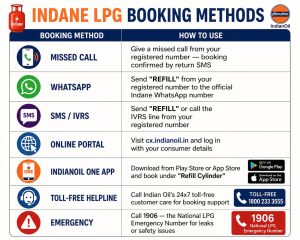
💡 Where to find official numbers: Always get the latest Indane booking numbers directly from cx.indianoil.in or the **IndianOil ONE app** — official numbers are updated there in real time.
🟢 How to Book Bharat Gas — Bharat Petroleum (BPCL)
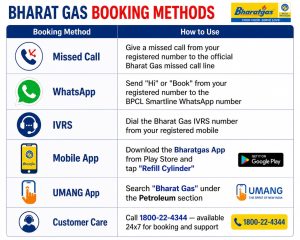
💡 Where to find official numbers: Always check my.ebharatgas.com or the Bharatgas App for the latest and verified booking numbers before calling.
🔴 How to Book HP Gas — Hindustan Petroleum (HPCL)
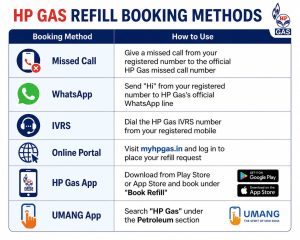
💡 Where to find official numbers: Always get HP Gas booking numbers directly from myhpgas.in or the official HPCL Twitter/X handle (@HPCL) — they regularly post verified booking numbers there.
⚠️ Why We’re Not Listing Specific Phone Numbers Here
Phone numbers for LPG booking are revised periodically by OMCs (Oil Marketing Companies). Printing outdated numbers in an article can directly harm readers — you could be calling the wrong line entirely. **Always verify your provider’s current booking number from their official app, website, or verified social media handle before calling.**
💡 Universal tip: The UMANG App — built by the Government of India — supports booking for *all three* providers from one single platform. It’s your safest, most future-proof option.
⏰ The New Booking Window Rules for May 2026
Previously, you could book a refill every 21 days. Now, urban households must wait at least 25 days between bookings, while rural consumers face a much longer 45-day gap — introduced as a supply rationalisation measure following the West Asia energy crisis. Don’t wait until your cylinder is on its last breath — book on the very first day your window opens. Set a phone reminder right now.
**Now its time to actually measure our LPG consumption needs proactively and secure our refill before it runs out as waiting period has now updated to 45 days so proactive booking is needed to avoid emergencies**
💬 What Real Indian Users Are Saying: Black Market Warnings & On-Ground Reality
Real people are feeling this hike deeply, and they’re talking about it openly — on Reddit, X (formerly Twitter), and in neighbourhood WhatsApp groups across every city. Here’s what keeps coming up.
🛒 The Black Market Cylinder Crisis
Users in wedding-heavy cities like Jaipur and Surat have flagged that LPG cylinders are being illegally sold at up to ₹4,000 per cylinder during peak wedding season demand. That’s nearly ₹1,000 above the official commercial rate — and completely illegal. Multiple users on Reddit warned that local distributors are citing “shortage” while cylinders are being quietly diverted. The government’s DAC-based OTP delivery system exists precisely to stop this from happening.
The Aadhaar eKYC Problem Nobody Warned You About
Many users on r/india and various consumer forums reported getting their bookings silently rejected — without any clear explanation. The culprit in most cases was an incomplete Aadhaar eKYC. The Ministry of Petroleum and Natural Gas has made it crystal clear: if you don’t share the OTP at the time of delivery, the cylinder will not be handed over — full stop. If your eKYC isn’t done yet, open your provider’s official app today and complete the biometric or OTP-based verification immediately.
👷 The Invisible Victims — Migrant Workers and the 5kg Cylinder Hike
A particularly painful trend flagged by users in Mumbai, Hyderabad, and Bengaluru: Indian Oil’s significant hike on the 5kg mini LPG cylinder — the lifeline of millions of migrants, daily-wage workers, and single-room households — has gone largely unnoticed in mainstream coverage. Many Reddit users described this as the “cruellest” part of the May 2026 hike, since these are precisely the households with the least financial cushion to absorb rising prices.
✅ The Silver Lining Users Are Reporting
Here’s some genuinely good news: consumers who completed their Aadhaar eKYC and switched to WhatsApp or app-based booking are reporting delivery times as fast as 24–48 hours in most metro areas. The digitalisation push — OTP verification, DAC codes, online-first booking — is inconvenient at first, but it’s clearly working to improve speed and accountability.
**The Digital booking channels for consumers who have done their KYC reported delivery times less or 24-48 hours so prefer digital channels if available for you**
🎓 Expert Quote — What the Analysts Are Saying
Sanjeev Prasad, MD & Co-Head at Kotak Institutional Equities, stated in a recent note that the West Asia war has made one thing brutally clear — India’s reliance on imported LPG is a structural vulnerability that can no longer be ignored. While the potential reopening of the Strait of Hormuz could ease supply shortages over the coming months, India must urgently reduce its dependency on imported energy and actively diversify its supply base to guard against future disruptions.
In simpler terms: this isn’t a one-month blip. The global energy supply chain is under genuine structural stress, and Indian consumers and businesses will need to plan around this new reality — not just for May 2026, but well beyond.
⚠️ Honest Disclaimer — What This Guide Cannot Guarantee
Here’s the truth no one tells you upfront: even if you do everything right — complete your eKYC, book on Day 1 of your window, use the correct method — **delivery delays can and do still happen.** The 25-day booking gap in urban areas and the 45-day gap in rural areas means that if you’re running dangerously low before your window reopens, you may genuinely be stuck. Distributors in Tier 2 and Tier 3 cities are currently reporting backlogs due to global supply chain stress. Track your gas level, book the moment your window opens, and — if you’re in a PNG-available area — seriously consider making the switch before the June 2026 deadline hits.
❓ FAQ — 5 Most Commonly Searched Questions About LPG Booking in May 2026
Q1. Has the price of my 14.2kg domestic cylinder increased in May 2026?
No — and this is genuinely good news for home cooks. The domestic 14.2kg LPG cylinder price has not changed for May 2026. It still stands at ₹913 in Delhi, ₹939 in Kolkata, ₹912.50 in Mumbai, and ₹928.50 in Chennai. *Only the 19kg commercial cylinder has seen the record-breaking hike this month.
Q2. What is the minimum waiting period between two LPG refill bookings in May 2026?
Urban households must now wait a minimum of **25 days** between consecutive bookings. If you live in a rural area, that gap extends to **45 days**, as part of the government’s supply rationalisation drive triggered by the West Asia energy crisis. Plan your usage and book the earliest day your window opens.
Q3. What happens if I refuse to share the OTP when the delivery agent arrives?
Simple — you won’t get your cylinder. The OTP is a mandatory anti-diversion security step introduced by the Ministry of Petroleum and Natural Gas. Ensure your registered mobile number is active, with you, and charged at the time of delivery — no exceptions.
Q4. Can I use the UMANG App to book cylinders for all three gas providers?
Yes, absolutely. The UMANG App — India’s Unified Mobile Application for New-age Governance — supports refill booking for Indane Gas, Bharat Gas, and HP Gas from a single platform. It’s especially handy if you’ve recently switched providers or just want to avoid managing multiple apps.
Q5. I have both a PNG connection and an LPG cylinder. Will my LPG connection be cancelled?
Quite possibly, yes. The government has formally begun identifying dual-connection households and has announced its intent to remove LPG connections from homes in societies that already have PNG infrastructure. The deadline for this is likely June 2026. If this applies to you, contact your LPG distributor immediately to understand your options before the deadline passes.
✅ Conclusion — Your Gas Booking Action Plan for May 2026
The May 2026 LPG hike is real, it’s historic, and it’s rooted in global geopolitical disruptions that are well beyond any of our control. The 19kg commercial cylinder has crossed ₹3,000 for the first time ever. The 14.2kg domestic cylinder, thankfully, is holding steady. Booking has gone almost entirely digital — and while the new OTP and DAC rules felt frustrating at first, they’re genuinely helping curb black market diversion. **Your one action today:** Open your gas provider’s official app or website right now, note when your 25-day window opens, and set a calendar reminder to book on that exact date. Don’t wait until your cylinder is on its last roti. Get your eKYC done, keep your OTP-linked number charged and with you — and you’ll be sorted.
Have you faced any booking issues this month, or has your delivery been delayed in your area? Drop your experience in the comments below — your story might genuinely help someone else navigate this! 👇
**We have learned how much geopolitics is affecting us today and Impact of digitization, being proactive with sense of social responsibility will make our lives less difficult**
💡 Bonus Section — 15 Detailed Tips to Save LPG During the 2026 Crisis Period
With cylinders now at record-high prices, every single flame counts. Here are 15 proven, practical habits to stretch your LPG further — with zero compromise on cooking quality.
🍳 Cooking Habits That Save the Most Gas
Tip 1 — Use a Pressure Cooker for Everything You Possibly Can
A pressure cooker uses up to **70% less gas** than an open pot for the same dish. Dal, rice, rajma, chole, vegetables, khichdi — all of it cooks faster and with dramatically less fuel. If your pressure cooker’s whistle or gasket is worn out, replace the seal immediately — a faulty seal bleeds both gas and pressure.
Tip 2 — Match Your Flame Size to Your Vessel Size
If your flame is spreading *beyond* the base of your vessel, that heat is escaping into the air — not your food. Keep the flame medium-low and directly under the pot at all times. You’ll use dramatically less gas and cook just as well.
Tip 3 — Always Cook With a Lid On
Cooking with a lid traps heat and steam inside, cutting cooking time significantly. Open-pot cooking loses enormous amounts of heat upward. A simple steel lid — or even a plate placed on top — saves more gas than you’d ever expect.
Tip 4 — Soak Pulses and Rice Before Cooking
Soaking dal, rajma, chole, and rice for just 30–60 minutes before cooking can cut your cooking time by **40–50%**. Less time on the flame means less gas used — and this one habit alone can meaningfully extend the life of a cylinder.
Tip 5 — Use Residual Pressure Cooker Heat
After the required number of whistles, **turn off the flame and let the pressure release naturally.** The food continues cooking in the trapped steam — completely for free. This works brilliantly for rice, dal, lentils, and most legumes.
Tip 6 — Cook in Sequence, Not in Isolation
Plan your meals smartly. When your pressure cooker is already hot after cooking dal, immediately start your next vessel using that residual warmth. Cooking items back-to-back without cooling the stove in between is one of the most underrated gas-saving habits.
Tip 7 — Thaw Food Completely Before Cooking
Never put cold or frozen food directly on the flame. Thaw it in the fridge overnight or at room temperature before cooking. Cooking frozen food directly requires significantly more gas to bring it up to temperature — an entirely avoidable waste.
Tip 8 — Use the Minimum Water Needed
Excess water in a vessel takes longer to heat — meaning more gas and more time. Use only as much water as your recipe genuinely needs. Less water also usually means better flavour concentration in most Indian dishes.
🌿 Smart Substitutes to Reduce Stove Usage
Tip 9 — Use a Microwave or Electric Kettle for Boiling Water
For boiling water — whether for chai, pasta, or blanching vegetables — an electric kettle is far more efficient than a gas flame. Use it whenever possible and transfer the hot water directly to your pot.
Tip 10 — Use an Induction Cooktop for Small Tasks
Boiling milk, making tea, heating small portions — these tasks are perfect for an induction cooktop. Electricity is currently still cheaper than LPG on a per-unit energy basis, making induction a genuinely smart short-term investment right now.
Tip 11 — Consider a Solar Cooker for Daytime Meals
Solar cookers are excellent for slow-cooking staples — dal, rice, sabzi — during the daytime, especially during India’s long sunny summer months. The fuel cost is absolutely zero.
📦 Maintenance, Storage & Financial Tips
Tip 12 — Keep Your Burners Clean at All Times
Clogged burner holes burn gas inefficiently. Clean them regularly with a pin or a thin brush. The rule of thumb is simple: a **clean blue flame** is an efficient flame. An orange or yellow flame is your signal that gas is being wasted — clean the burner immediately.
Tip 13 — Store Your Cylinder Correctly
LPG is a liquid stored under pressure. Storing cylinders in direct sunlight or near heat sources causes pressure changes that reduce the amount of usable gas. Always store your cylinder **upright, in a well-ventilated area, away from heat-emitting appliances.**
Tip 14 — Check Your Government Subsidy — Don’t Leave Money Behind
Eligible Pradhan Mantri Ujjwala Yojana (PMUY) beneficiaries continue to receive Direct Benefit Transfer